How it works#
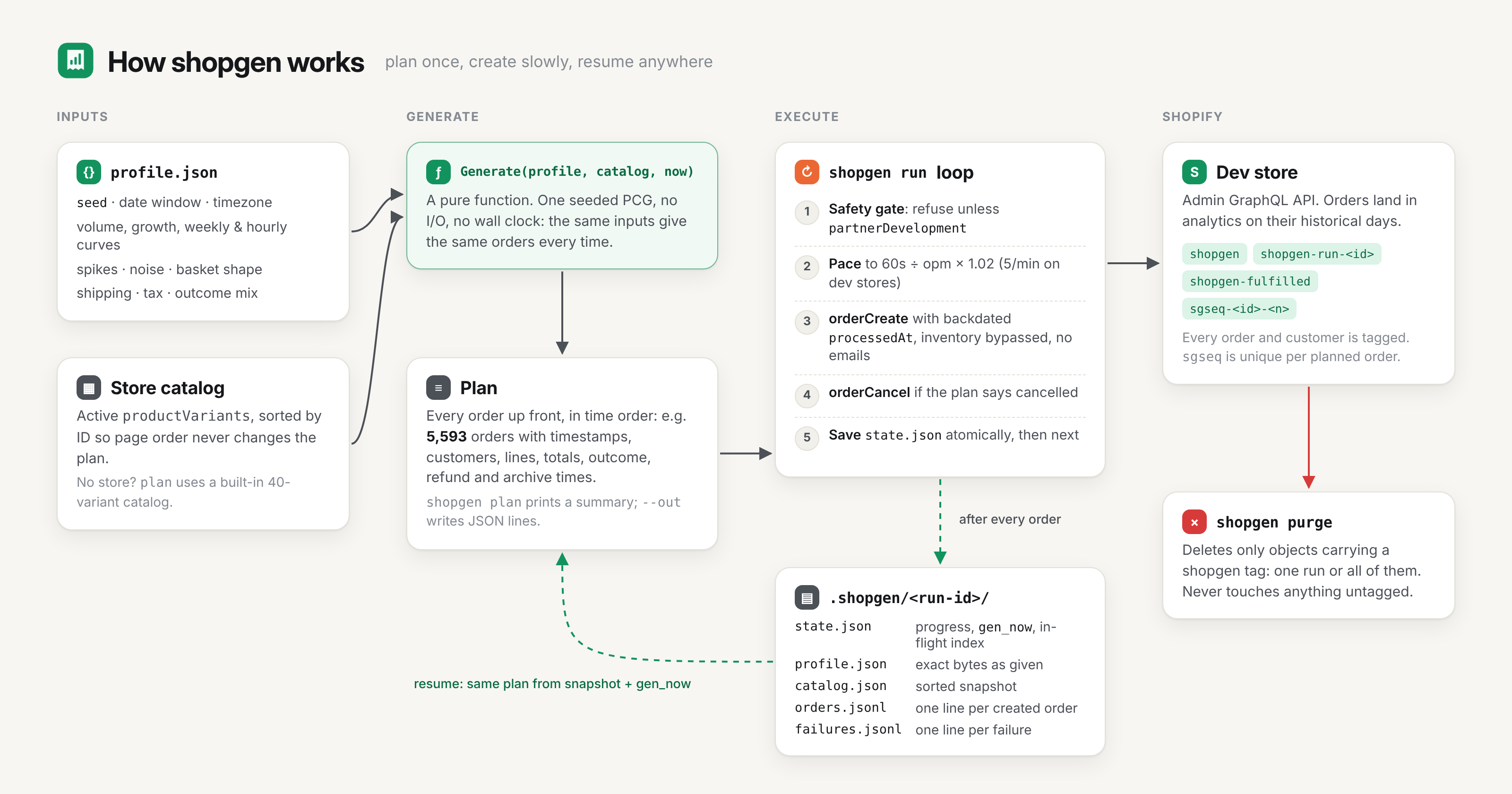
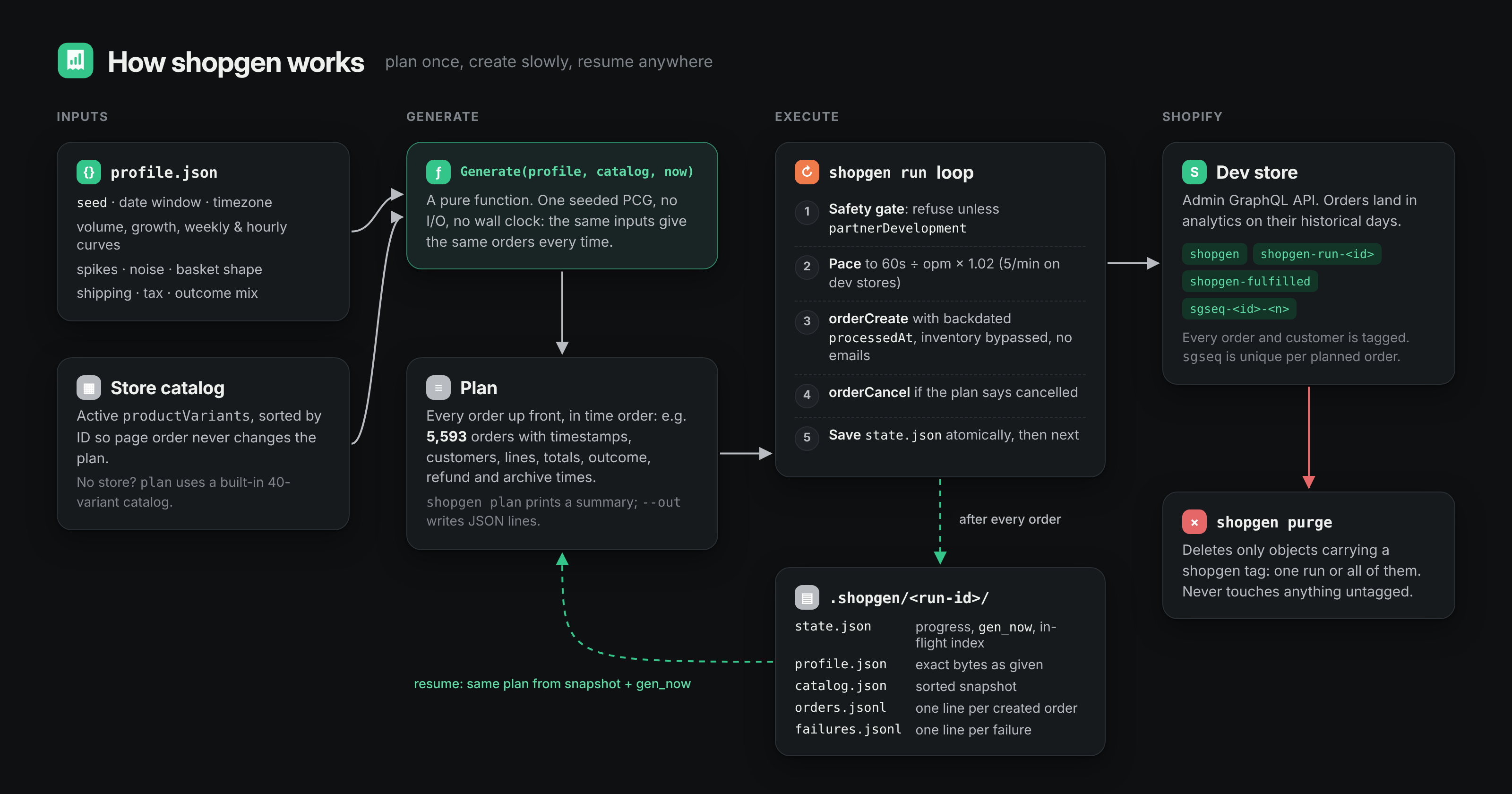
shopgen splits the job into a pure planning step and a slow, resumable execution step. Planning takes milliseconds; execution takes hours because of Shopify's dev-store limit. Keeping them apart is what makes stopping and resuming safe.
Generation#
Generate(profile, catalog, now) → Plan (in gen.go) has no I/O. Determinism is its first rule, because resume depends on regenerating exactly the same plan:
- One seeded PRNG. A
math/rand/v2PCG seeded fromseed. No globalrand, no map iteration order, no wall clock. - Sorted inputs. The catalog is sorted by variant ID and de-duplicated before use, so the order of API pages can't change anything. Outcome keys are sorted before their weights are built.
nowis a parameter. It drops timestamps in the future and drives the recency rules. A run records it once asgen_now.- Customers stand alone.
CustomerAt(profile, i)uses its own PRNG seeded by(seed, i), so customer i is identical however the plan was built.
For each day it computes the expected volume (see the formula), draws that many local timestamps from the hourly curve, sorts them, and builds each order in time order: customer, basket, shipping, tax, outcome, refund and archive times. Because orders are created in time order, Shopify's order numbers rise with date, just as in a real store.
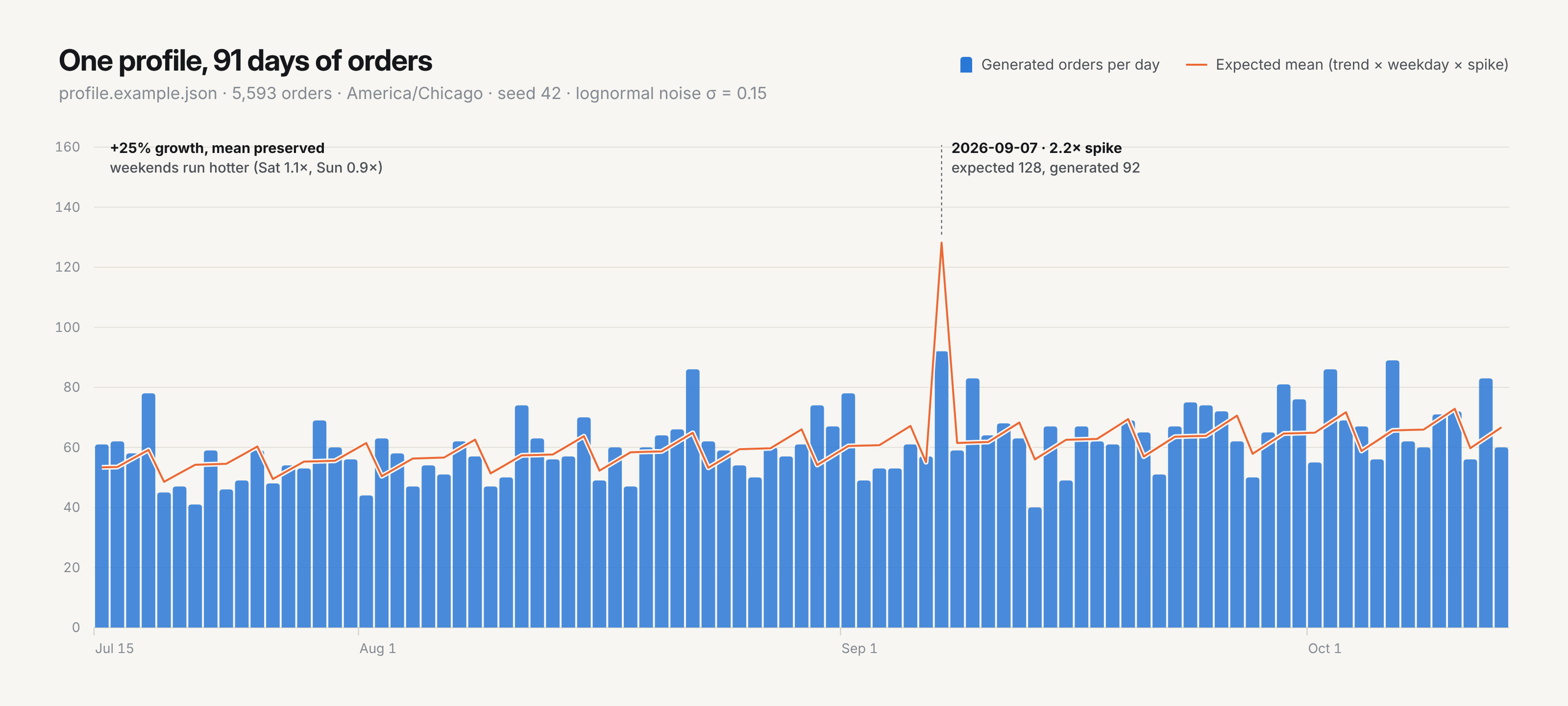
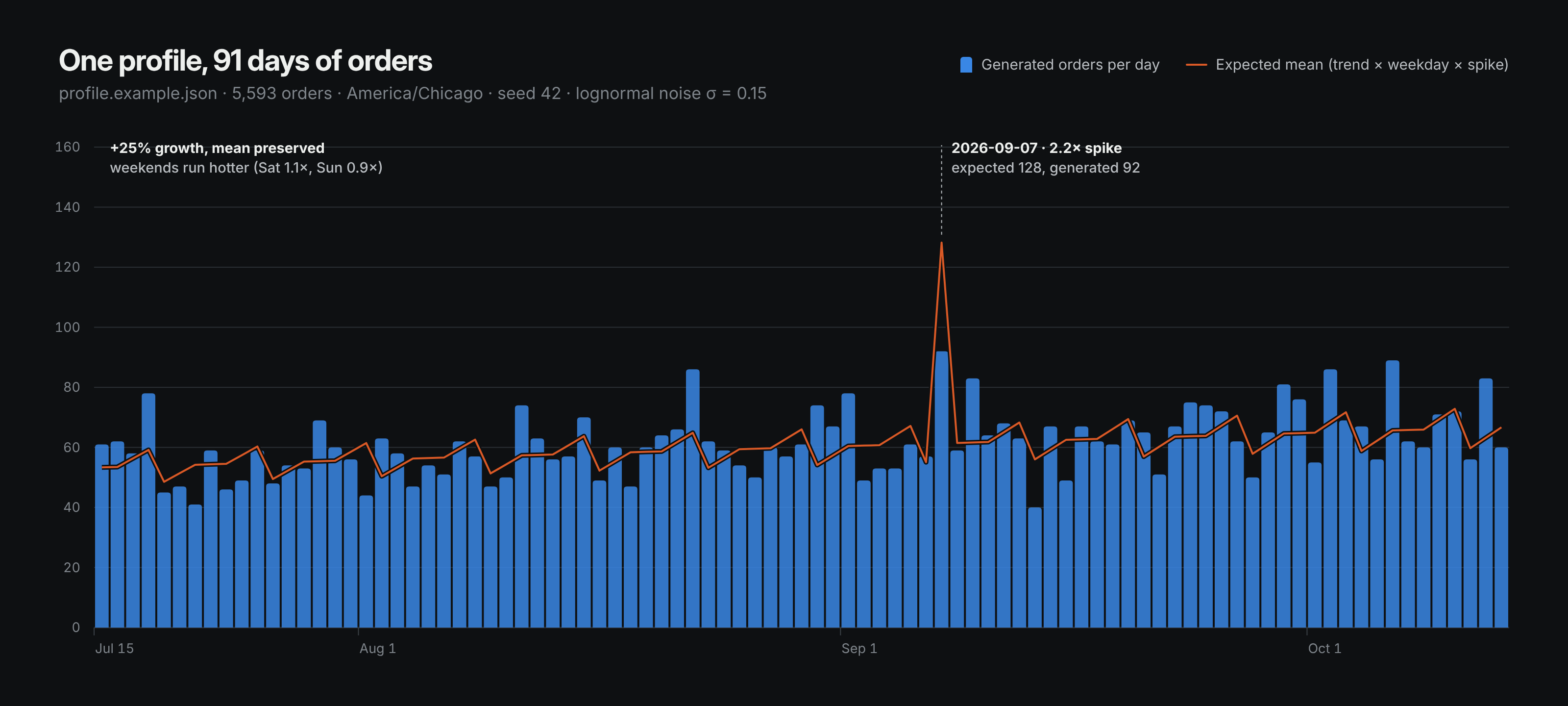
Money is integer cents throughout. Floating point appears only while computing tax, which is immediately rounded.
Execution#
Startup#
- Safety gate.
query { shop { name myshopifyDomain plan { partnerDevelopment } } }. Not a dev store and no--allow-non-dev: exit before any write. - Scope check. List the token's granted scopes (
/admin/oauth/access_scopes.json, via go-shopify) and stop ifread_products,write_ordersorwrite_customersis missing. Awrite_scope implies itsread_scope. If the list can't be fetched, shopgen warns and lets the first write decide. - New run. Read the profile bytes, fetch and sort the catalog, create a run ID
YYYYMMDD-<6 hex>, and writeprofile.json(the exact bytes),catalog.jsonandstate.jsonwithgen_nowinto.shopgen/<run-id>/. - Resume. Load those three files from the run directory. Never re-read the original profile path, never re-fetch the catalog. Regenerate the plan with the stored
gen_nowand refuse to continue if the order count differs fromstate.total, or ifprofile.jsonno longer matches its recorded hash.
The loop#
For each index from done to total:
- Stop if
--limitsuccesses have been reached this session. - Pace: wait until the previous start + 60 s ÷ opm × 1.02. The 2% headroom keeps clock skew from tripping the 5/min cap. Ctrl-C during the wait pauses immediately.
- Record
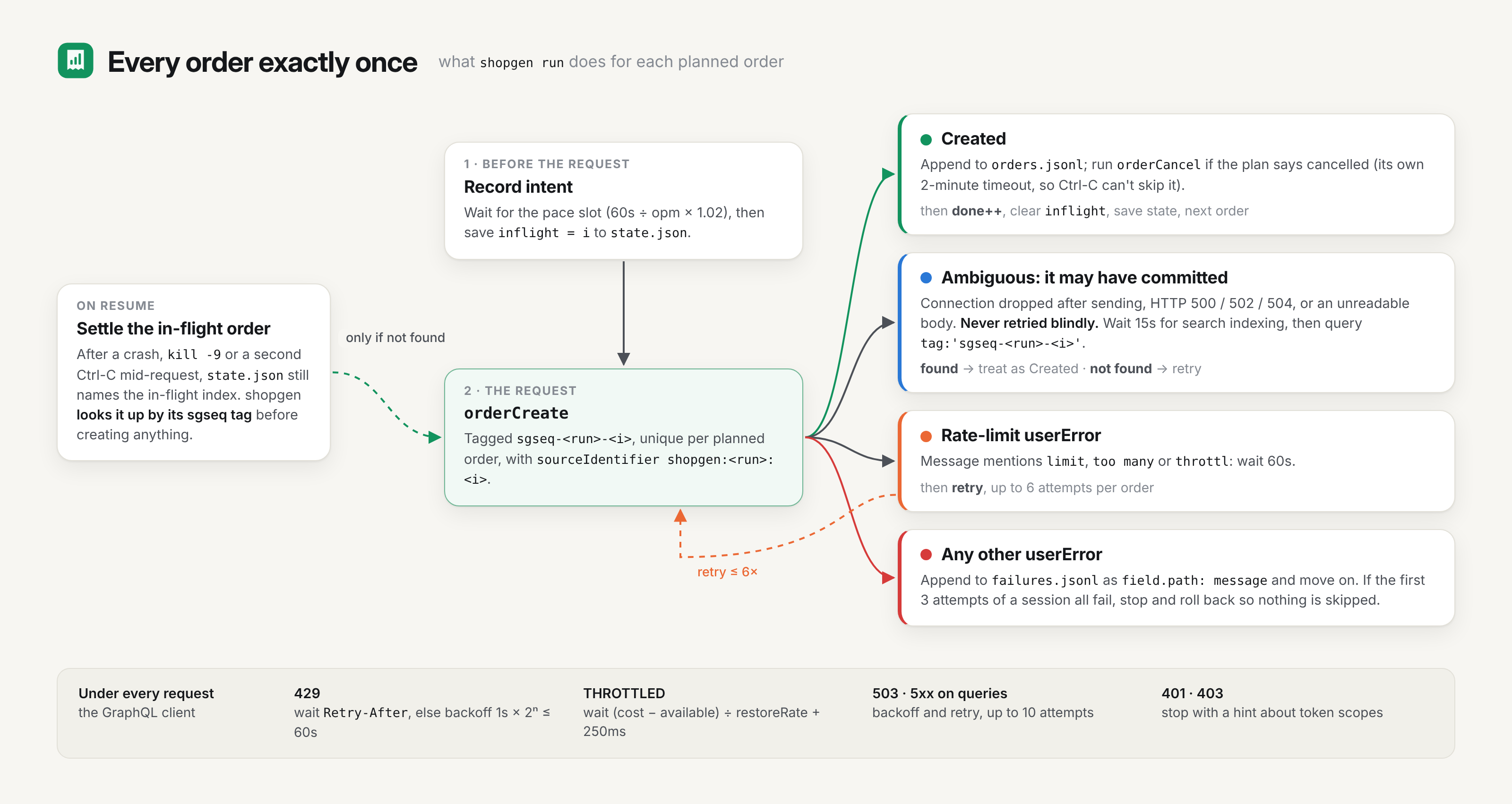
inflight = indexinstate.json. - Create the order (below). On success append to
orders.jsonland, if the plan says so,orderCancel. On failure append tofailures.jsonl. - Advance
done, clearinflight, rewritestate.json.
Fail fast: if the first three attempts of a session all fail, shopgen rolls done back so those orders aren't skipped, saves, and exits with a message telling you to fix the cause and resume. A bad scope or an archived product fails loudly instead of burning through the plan.
Exactly once#
A mutation that might have committed is never simply retried. The client returns ErrAmbiguous when:
- the request was written but the connection failed before a reply (detected with
httptrace, so a failure before sending is safely retried), - a mutation gets HTTP 500, 502 or 504,
- a mutation's response body can't be read or decoded.
On ErrAmbiguous, shopgen waits 15 seconds for search indexing and queries orders(query: "tag:'sgseq-<run>-<index>'"). Found: the order exists, so record it as created. Not found: retry. Each order gets at most six attempts.
orderCreate userErrors mentioning limit, too many or throttl wait 60 seconds and retry within the same budget. Any other userError fails the order and is recorded as field.path: message.
The inflight marker covers what the in-process retry can't: a crash, kill -9, or a second Ctrl-C that abandons a request mid-flight. On resume, if inflight equals done, shopgen looks that order up by tag before creating anything, and cancels it if it should have been cancelled.
Signals#
| You press | shopgen does |
|---|---|
| Ctrl-C while pacing | Pauses immediately, saves, prints the resume command |
| Ctrl-C mid-request | Lets the in-flight order (and its cancel) finish, then pauses |
| Ctrl-C twice | Abandons the in-flight request; resume reconciles it by tag |
orderCancel runs with its own two-minute context, so a Ctrl-C between create and cancel never leaves a planned-cancelled order open.
The GraphQL client#
Do(ctx, query, vars, out) makes up to 10 attempts:
| Response | Action |
|---|---|
429 |
Wait Retry-After seconds, else exponential backoff |
503, or any 5xx on a query |
Backoff and retry |
500/502/504 on a mutation |
ErrAmbiguous (see above) |
401 with client credentials |
Fetch a new token and resend once (a rejected token means nothing ran, so even a mutation is safe to resend) |
401 / 403 otherwise |
Fail immediately with a hint about scopes |
Other 4xx |
Fail with the body, truncated to 500 characters |
GraphQL THROTTLED |
Wait max(requested − available, 1) ÷ restoreRate + 250 ms, from extensions.cost.throttleStatus |
| Other GraphQL errors | Fail with their messages joined |
Backoff is 1 s × 2^(attempt − 1), capped at 60 s. Every sleep honors cancellation. The HTTP timeout is 60 s.
Access tokens#
Requests get their token from a TokenSource. SHOPIFY_ACCESS_TOKEN becomes a fixed token. SHOPIFY_CLIENT_ID plus SHOPIFY_CLIENT_SECRET become a ClientCredentials source, which runs the client credentials grant, caches the 24-hour token, renews it five minutes before expiry, and renews it early if Shopify answers 401.
State files#
Written atomically (write *.tmp, fsync, rename), so a crash never leaves a half-written file.
| File | Contents |
|---|---|
state.json |
run_id, store, profile_hash, gen_now, total, done (next index), created, failed, inflight, started_at, updated_at |
profile.json |
The profile exactly as given |
catalog.json |
The sorted catalog snapshot (ID, title, price in cents) |
orders.jsonl |
One line per created order: index, id, name, outcome, processed_at |
failures.jsonl |
One line per failure: index, error, time, and order_id for cancel failures |
orders.jsonl gives you a ready-made map from plan index to Shopify order ID, handy for asserting on reports in tests.
Purge#
Purge deletes only objects carrying a shopgen tag: shopgen-run-<id> with --run, shopgen with --all.
- Page through
orders(first: 50, query: "tag:'<tag>'"). For each order,orderDelete. If Shopify refuses and the order isn't cancelled,orderCancel(no refund, no restock, no notification), then delete again. Orders that still fail are remembered and skipped on later pages. - Do the same for
customers(...)withcustomerDelete. Customers who still have orders can't be deleted and are counted as kept.
Search indexing can lag a little behind deletes, so a second purge a minute later sometimes catches stragglers.
Code layout#
| Path | What's in it |
|---|---|
main.go |
Calls cmd.Execute() |
cmd/ |
The cobra commands, one file each (root, plan, run, purge, doctor, version), and viper configuration in root.go |
internal/shopgen/ |
Profiles, Generate, the run loop, state files, purge and doctor |
internal/shopify/ |
The GraphQL client, typed operations, order input types, token sources, and helpers for store domains, admin URLs, GIDs, money and scopes |
internal/shopify/shopifytest/ |
An in-memory fake Admin API with fault injection, used by every store-facing test |
internal/ui/ |
lipgloss styling, log lines and the pacing countdown |